
Grundy, Kendall and Will
Hydroseeding in Minooka, IL
A railroad village that nearly tripled in size in the 2000s, on flat, dark prairie ground.
- No-charge yard walk-throughs with a quote in writing
- Seed mix matched to the sun, shade and soil on your lot
- Watering and first-mow instructions in writing with every job
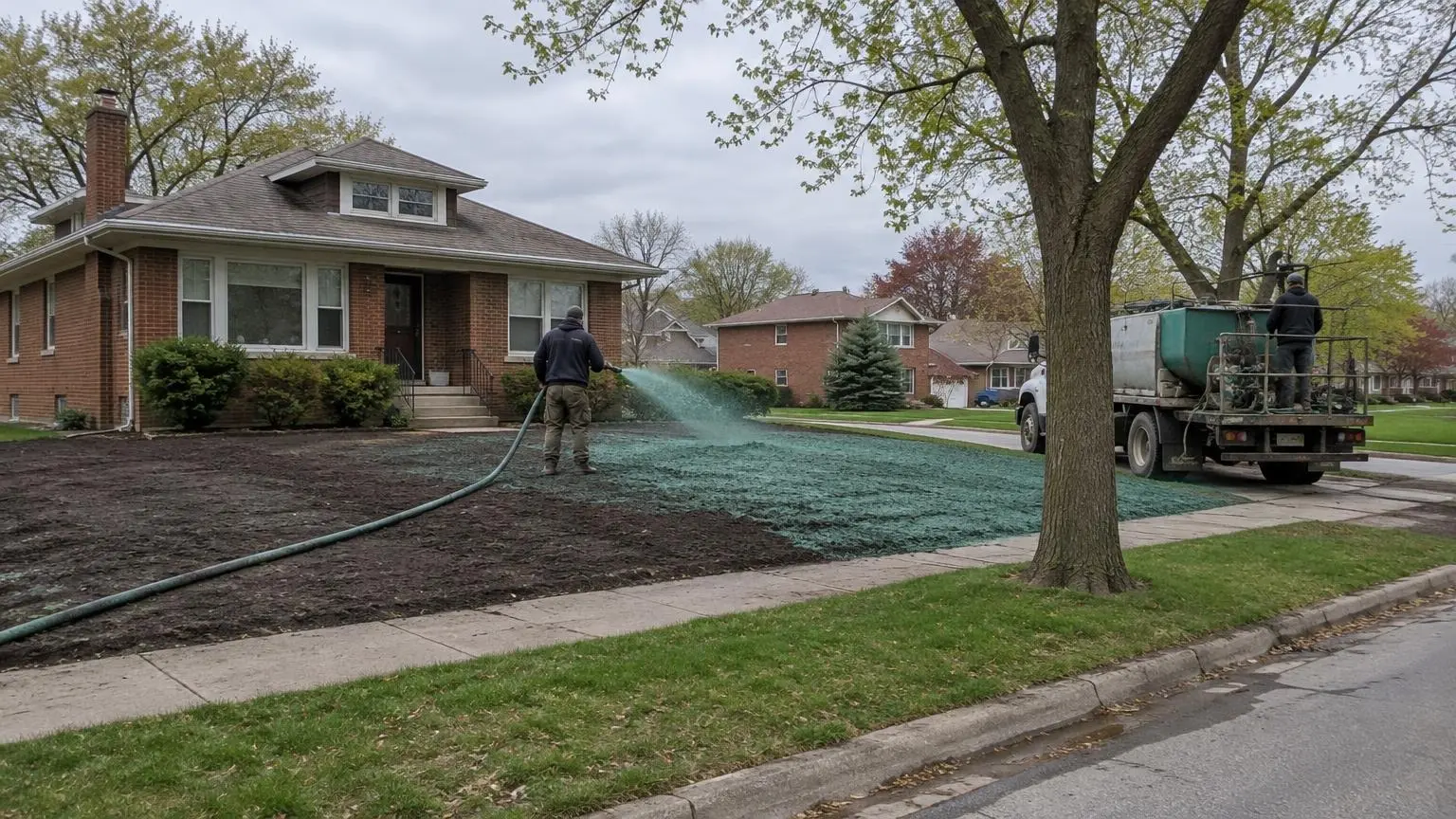
Flat Black Soil at the Southwest Edge
Hydroseeding in Minooka mostly means first lawns on newer homes. The village was established in 1852 when the railroad came through, stayed small for over a century and then jumped from 3,971 residents in 2000 to 10,924 in 2010, a 175 percent increase. It reached 12,758 in 2020. Its limits now cover parts of Grundy, Kendall and Will counties.
Low, flat ground
At about 597 feet, Minooka sits lower than most of the suburbs to its north and east. Flat, low prairie land in northern Illinois commonly has poorly drained soils like Drummer, a black silty clay loam on nearly level plains with slopes of 0 to 2 percent. That soil is fertile, but water sits on it. Getting positive drainage on each lot before seeding is the most important step.
River on the east side
The DuPage River, flowing south toward the Des Plaines, forms part of the village's eastern boundary. Lots near the river or its drainage ways should keep silt fence up during construction and get a fast cover of seed and mulch once grading is done.
Builder lots and swales
In newer subdivisions, the rear-yard swale is often where seed fails first. It carries the neighbors' water, so it needs a blanket or heavy mulch in the flow line, not just a light spray. We also check that the swale actually falls toward its outlet.
Three counties, one village
Because the village spans three counties, larger projects can fall under different county stormwater reviewers. Builders should confirm which rules apply before grading.
Get a free estimate or call (312) 598-0845.
Minooka Facts
- 2000s boom. Minooka grew from 3,971 residents in 2000 to 10,924 in 2010, a 175.1 percent increase.
- Three counties. The village center is in the northeast corner of Grundy County, with limits reaching into Kendall and Will counties.
- DuPage River. The DuPage River, a south-flowing tributary of the Des Plaines, forms part of Minooka's eastern boundary.
- Railroad founding. Minooka was established in 1852 when the railroad was built through the area, and incorporated in 1869.
Minooka Questions
Why does my new Minooka lawn stay soggy?
Flat, dark prairie soil holds water. Before seeding, the lot needs a positive grade that carries runoff off the foundation and into a swale.
Our rear swale washes out every storm. What fixes it?
Reshape it to drain, then line the flow path with a blanket or heavy mulch.
Do you work in the Grundy, Kendall and Will County parts of the village?
Yes, all three.
Can you do silt fence for a lot near the DuPage River?
Yes, before grading, kept in place until the grass is established.
Free Estimates in Minooka, IL
New home in Minooka? Get a lawn estimate.
Hydroseeding Near Minooka
- Hydroseeding in Chicago, IL
- Hydroseeding in Naperville, IL
- Hydroseeding in Aurora, IL
- Hydroseeding in Joliet, IL
- Hydroseeding in Plainfield, IL
- Hydroseeding in Oswego, IL
- Hydroseeding in Yorkville, IL
- Hydroseeding in Elgin, IL
- Hydroseeding in Huntley, IL
- Hydroseeding in Lockport, IL
- Hydroseeding in Lemont, IL
- Hydroseeding in Crystal Lake, IL
- Hydroseeding in Highland Park, IL
- Hydroseeding in Lake Forest, IL
- Hydroseeding in Bolingbrook, IL
- Hydroseeding in New Lenox, IL
- Hydroseeding in Algonquin, IL
- Hydroseeding in St. Charles, IL
- Hydroseeding in Romeoville, IL
- Hydroseeding in Lake in the Hills, IL
- Hydroseeding in Wheaton, IL
- Hydroseeding in Lisle, IL
- Hydroseeding in Gurnee, IL