
Seed-ready ground
Grading, Topsoil & Dirt Work in Chicago, IL
Moving water away from the house and putting real soil under the seed.
- No-charge yard walk-throughs with a quote in writing
- Seed mix matched to the sun, shade and soil on your lot
- Watering and first-mow instructions in writing with every job
Good Lawns Start With the Grade
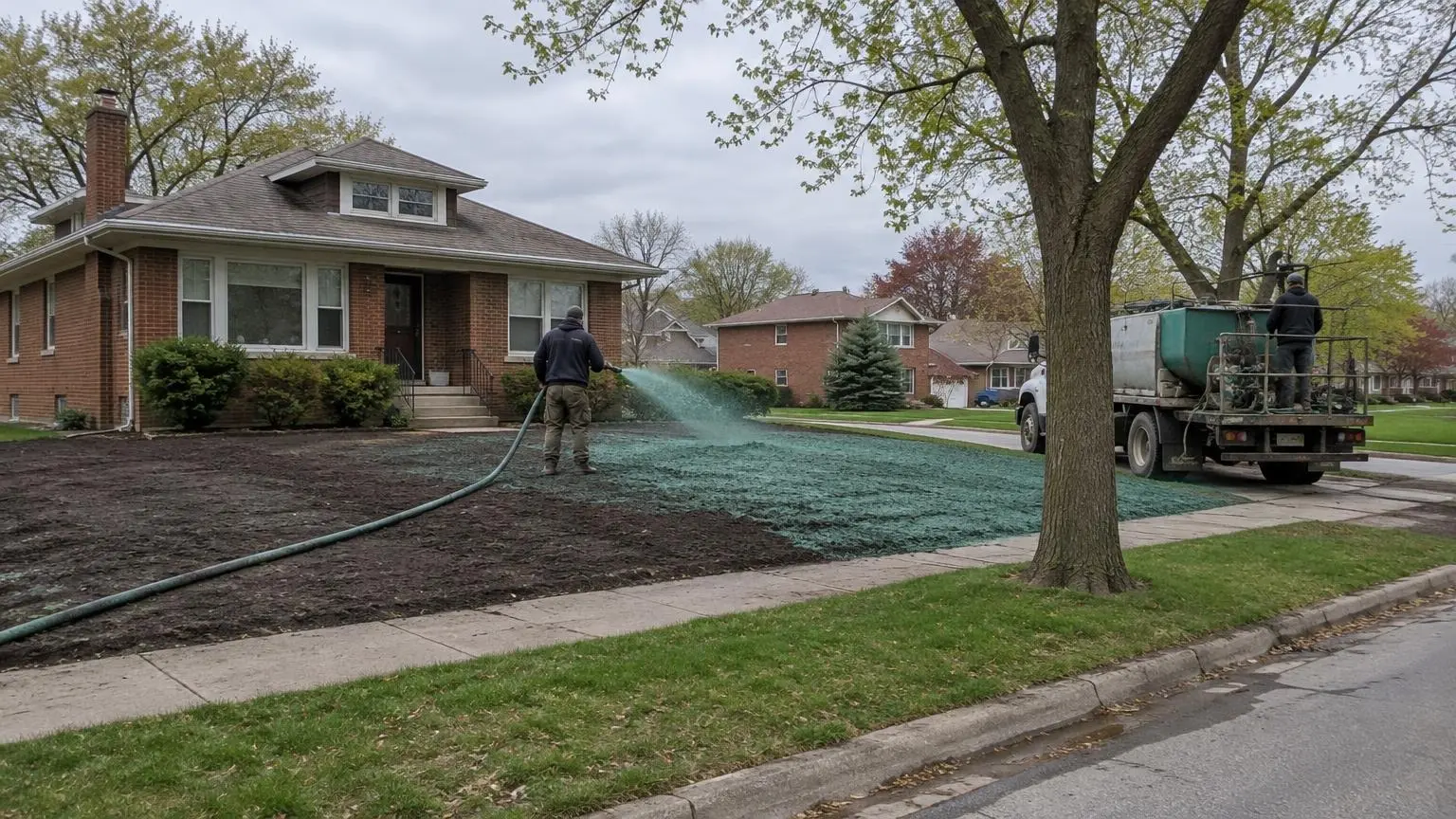
Grading, topsoil & dirt work is the part of a lawn or site job that happens before any seed goes down, and around Chicago it often decides whether a lawn thrives or fails. We regrade yards that hold water, rebuild slopes that pitch toward the foundation, bring in and spread topsoil where builders left subsoil, and fine grade the surface so hydroseed lands on smooth, firm ground. Our grading crews also handle the small excavation and trenching that comes with drainage fixes.
Flat ground, slow drainage
Chicago is famous for being flat. The city's natural grade varies only slightly, and in 1856 the city approved a sewer plan that went on to raise much of central Chicago to a new grade. In the suburbs the land rolls more, but the soils are mostly silts and clays over glacial till. The USDA describes soils like Markham as slowly permeable with a perched water table two to three and a half feet down in spring, and the state soil, Drummer, as poorly drained. Put those together and a yard that is graded a little wrong will hold water for days. Yard grading here is less about moving big piles and more about a steady slope that carries water off the foundation and out to a swale or the street.
Yard grading and land grading
For most homes, the job is to slope the first several feet away from the foundation, fill low spots where water pools, and shape a path for runoff to leave the yard. On larger properties and sites, land grading means setting elevations to a plan, shaping swales and berms, and making sure each area drains to where the engineer intended. We use laser or string lines to check fall instead of eyeballing it on flat lots, because a few inches over a long distance is the difference between draining and ponding.
Topsoil
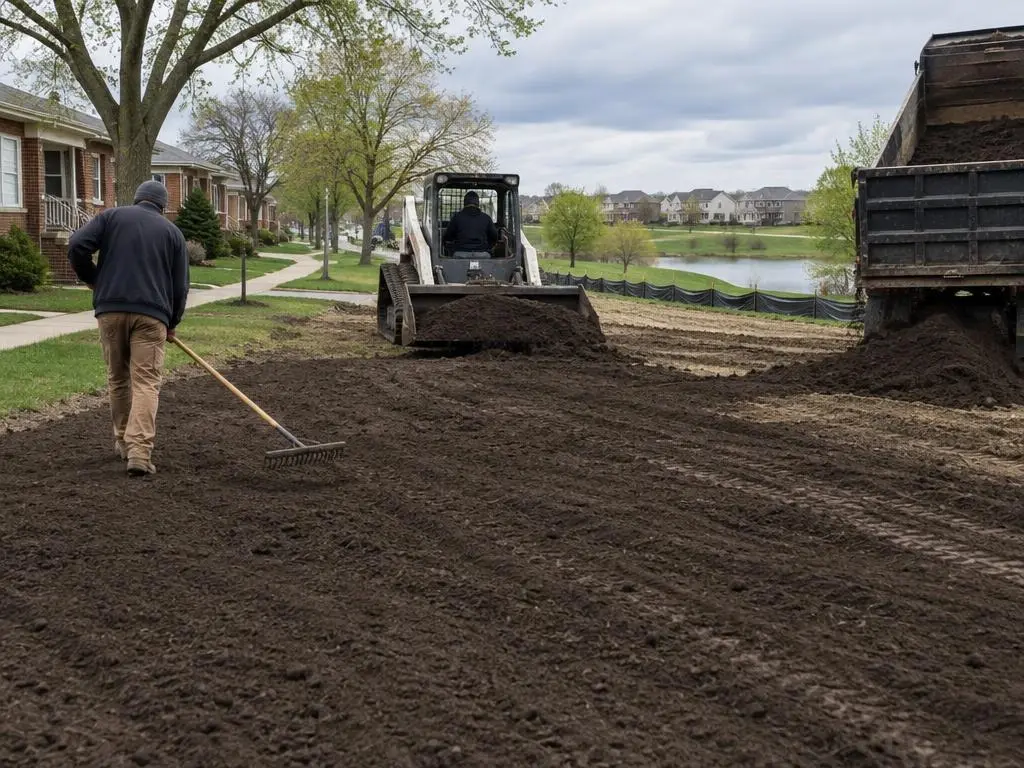
The dark top layer of a typical local soil profile is thin. In the USDA's Markham description, the surface layer is only six to nine inches over a clay-rich subsoil. When a lot is scraped and regraded, that topsoil is easily lost or buried. Seed will sprout on subsoil but root poorly. We bring in screened topsoil, spread it to a useful depth over loosened ground, and blend the contact zone so water and roots move between layers instead of stopping at a hard line. We tell you how much we think the yard needs and why.
Dirt work, excavation and trenching
Drainage problems often need more than a grade change. We dig shallow trenches for downspout extensions and drain lines, cut swales between houses, remove excess fill, and haul away spoil or debris. Larger excavation, such as foundations or deep utility work, is outside what we do, but small excavation and trenching tied to grading and drainage is routine for our crews. Before any digging, we have underground utilities marked.
Fine grading for seed
The last pass is fine grading: raking out stones and clods, firming soft spots and leaving a smooth, slightly loose surface. Illinois Extension notes that a planting bed should be firm enough that you do not leave footprints, since any dent covered by new grass becomes a bump or dip in the lawn. That is what we aim for right before spraying hydroseed.
Grading near trees, walks and neighbors
On established lots, grading has to work around things that are already there. Adding soil over tree roots can harm mature trees, so we keep fill shallow near trunks and route water around them instead. Along sidewalks, patios and driveways, finished grade should sit just below the paved edge so grass grows level with it rather than spilling over. On narrow city and inner-suburb lots, we pay attention to where water goes once it leaves your yard. Pushing runoff onto a neighbor's property solves your problem by creating theirs, and it is the kind of thing that leads to complaints. Our aim is to send water where the lot was designed to shed it, whether that is the curb, a swale or a drain.
Weather and soil moisture
Clay soil that is worked wet turns into dense clods and smears into a slick layer that water cannot get through. We schedule grading when the ground is workable, which can mean waiting a few days after a heavy rain. In a wet spring that can push grading back a week or two, and we would rather wait than leave you with a sealed, cloddy surface that grass struggles in for years.
Cost
Grading and topsoil are priced by area, by how much soil has to move, and by access. The table lists published national ranges for leveling, land grading and topsoil from named cost guides. On many jobs this is the biggest line on the estimate, which is why we show it separately. Whatever the signed quote says is what you pay.
Dirt Work We Do
Everything between bare ground and seed-ready soil.
Yard grading
Slope away from the foundation, low spots filled and a path for runoff.
Land grading to plan
Elevations, swales and berms set to the engineer's drawings.
Topsoil delivery and spreading
Screened topsoil spread over loosened subsoil at a useful depth.
Small excavation and trenching
Drain lines, downspout extensions and swale cuts tied to drainage fixes.
Fill removal and hauling
Excess dirt, debris and spoil hauled off site.
Fine grading
Final raking and firming so the seed bed is smooth and even.
Typical Grading and Topsoil Costs
| Item | Published range |
|---|---|
| Yard leveling, per sq ft (HomeAdvisor) | $1 to $2 |
| Land grading, per sq ft (Lawn Love) | $0.08 to $2.00 |
| Fine grading, per sq ft (Lawn Love) | $0.08 to $1.00 |
| Residential resloping, per project (Lawn Love) | $770 to $3,000 |
| Topsoil, per cubic yard (HomeAdvisor) | $12 to $55 |
| Delivering a load of topsoil, 15 cu yd max per trip (Angi) | $50 to $150 |
National ranges from the named guides, not Chicago quotes. Material, delivery and spreading are often priced separately. Guide ranges, not a bid. The bid we hand you after the visit is binding.
How a Grading Job Runs
1. Survey the yard
We check elevations, find where water sits and decide where it should go.
2. Locate utilities
Underground utilities are marked before any digging or trenching.
3. Rough grade
Soil cut and filled to set the fall away from the house.
4. Topsoil
Screened topsoil spread and blended into loosened subsoil.
5. Fine grade and seed
Surface raked smooth and firm, ready for hydroseed the same week.
Why Choose Us for Grading, Topsoil & Dirt Work
Measured fall
Lines and levels, not guesses, on flat lots.
Grading and seeding together
No gap between the dirt crew and the seed crew.
Clear topsoil numbers
You see how much soil is going in and why.
Grading, Topsoil & Dirt Work Questions
How deep should topsoil go under a new Chicago lawn, and how many yards is that?
That comes down to the soil you already have. We probe the ground on the site visit and tell you the depth we recommend and how many cubic yards that works out to for your area.
Water collects by my foundation after storms. Can grading solve that?
Usually, yes. We reshape the soil so it slopes off the foundation and give the water somewhere to go, sometimes with a downspout extension or shallow drain.
Do you do excavation and trenching?
We handle small excavation and trenching tied to grading and drainage, such as drain lines and swale cuts. Foundations and deep utility work are for an excavation contractor.
Should I grade in fall or spring?
Either works if the soil is not soaked. Grading in summer lets you seed in the late summer window that Illinois Extension recommends for northern Illinois.
Grading, Topsoil & Dirt Work Service Areas
- Hydroseeding in Chicago, IL
- Hydroseeding in Naperville, IL
- Hydroseeding in Aurora, IL
- Hydroseeding in Joliet, IL
- Hydroseeding in Plainfield, IL
- Hydroseeding in Oswego, IL
- Hydroseeding in Yorkville, IL
- Hydroseeding in Elgin, IL
- Hydroseeding in Huntley, IL
- Hydroseeding in Lockport, IL
- Hydroseeding in Lemont, IL
- Hydroseeding in Crystal Lake, IL
- Hydroseeding in Highland Park, IL
- Hydroseeding in Lake Forest, IL
- Hydroseeding in Bolingbrook, IL
- Hydroseeding in New Lenox, IL
- Hydroseeding in Algonquin, IL
- Hydroseeding in St. Charles, IL
- Hydroseeding in Romeoville, IL
- Hydroseeding in Lake in the Hills, IL
- Hydroseeding in Wheaton, IL
- Hydroseeding in Minooka, IL
- Hydroseeding in Lisle, IL
- Hydroseeding in Gurnee, IL
Get a Grading, Topsoil & Dirt Work Estimate
Free grading and drainage walk-throughs in Chicagoland.