
Ravines, berms, swales and ditches
Slope & Swale Erosion Control in Chicago, IL
Holding soil in place on the ground that washes out first.
- No-charge yard walk-throughs with a quote in writing
- Seed mix matched to the sun, shade and soil on your lot
- Watering and first-mow instructions in writing with every job
Where Water Moves, Soil Follows
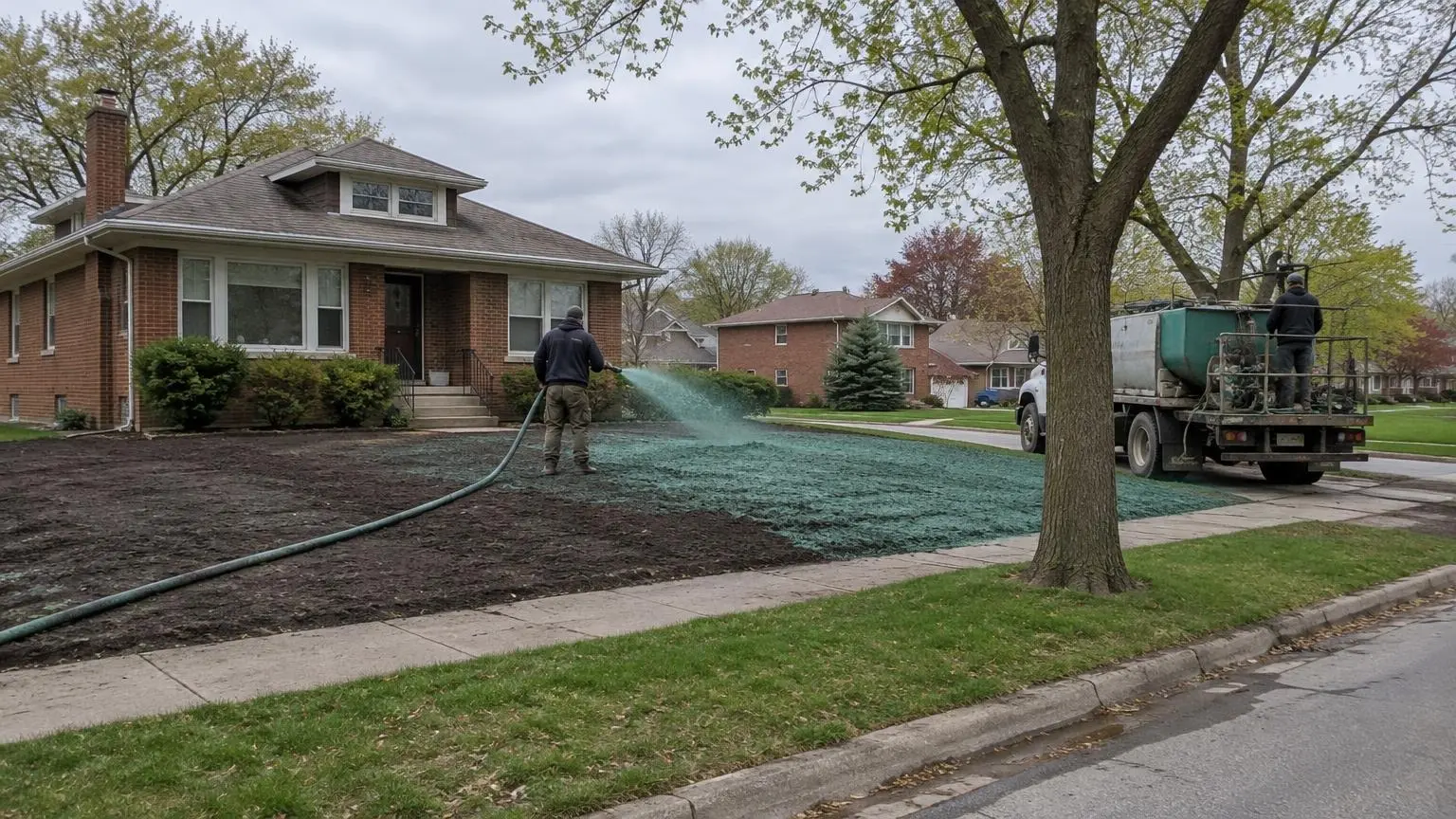
Slope & swale erosion control is the work of keeping soil where it belongs on the parts of a property that carry water: backyard drainage swales, ditch lines, detention basin banks, berms, ravine edges and steep yards in Chicago and the suburbs. Seed alone cannot hold these places in the first weeks, because water moves faster there than roots can grow. We cover them with erosion control blankets, hydromulch or bonded fiber matrix, seed them at the same time, and let the grass take over the job as it fills in.
Why it matters here
Most of the Chicago area is flat, which surprises people when we talk about erosion. But flat ground is exactly why swales matter: subdivisions are graded so that yards drain to shallow swales along lot lines and then to basins and storm sewers. Those swales carry every storm. Chicago's climate normals show May as the wettest month, with most rain arriving in thunderstorms, so a newly graded swale may see a hard downpour before seed even germinates. On the North Shore and along river valleys like the Fox and Des Plaines, there are real slopes, ravines and bluffs where bare soil can slide or gully quickly. And the region's clay-rich soils, slow to soak up water according to the USDA's description of soils like Markham, send more of each storm across the surface instead of into the ground.
Erosion control blankets
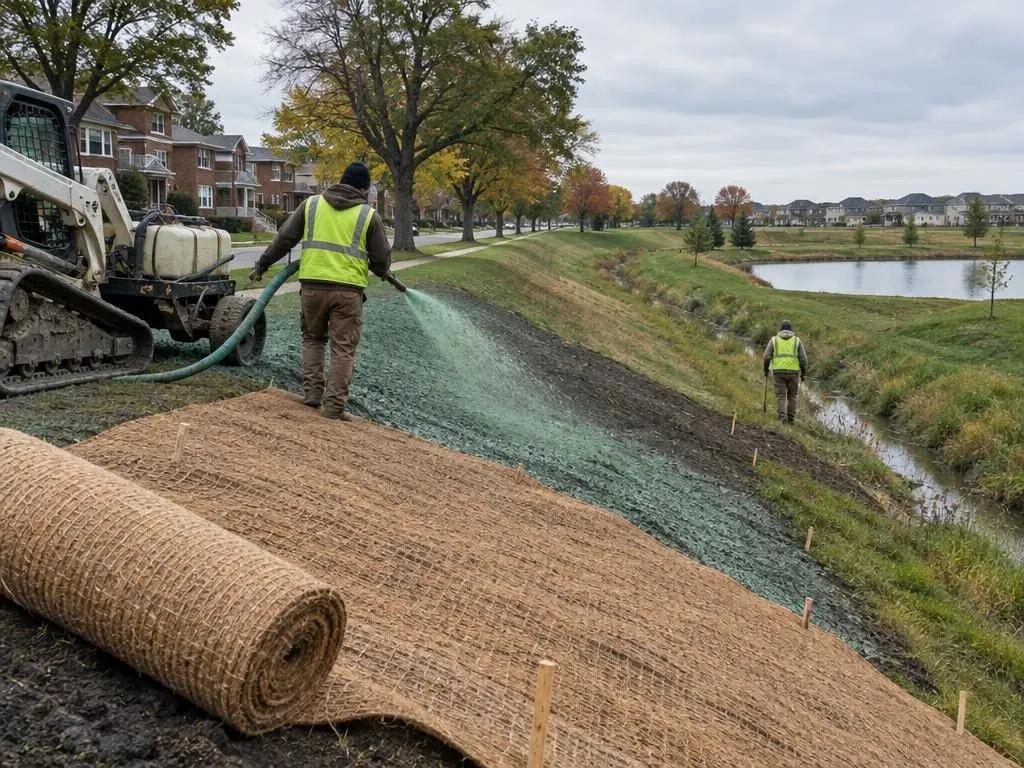
Straw blankets, straw and coconut blends, and all-coir blankets are rolled out over seeded soil and stapled down. They protect seed from raindrop impact, slow sheet flow and hold moisture. Straw breaks down in a season or so; coir lasts longer and suits channels and steeper banks. In swales we run blankets lengthwise with the flow, overlap the upstream edge on top, and trench in the top end so water cannot get underneath. Straw blankets are our default for most residential swales.
Hydromulch and bonded fiber matrix
Hydromulch is wood or paper fiber sprayed in the same slurry as the seed, at higher rates than a flat lawn would get. On moderate slopes it is often enough. Bonded fiber matrix, or BFM, adds a bonding agent so the mulch dries into a continuous mat that holds up to rain on steeper ground where blankets are hard to install. Hydro mulching is faster than rolling blankets on big, irregular slopes, and it leaves no netting behind. We choose between blankets, heavy hydromulch and BFM by slope, flow and how soon the area might see a storm.
Slope stabilization in practice
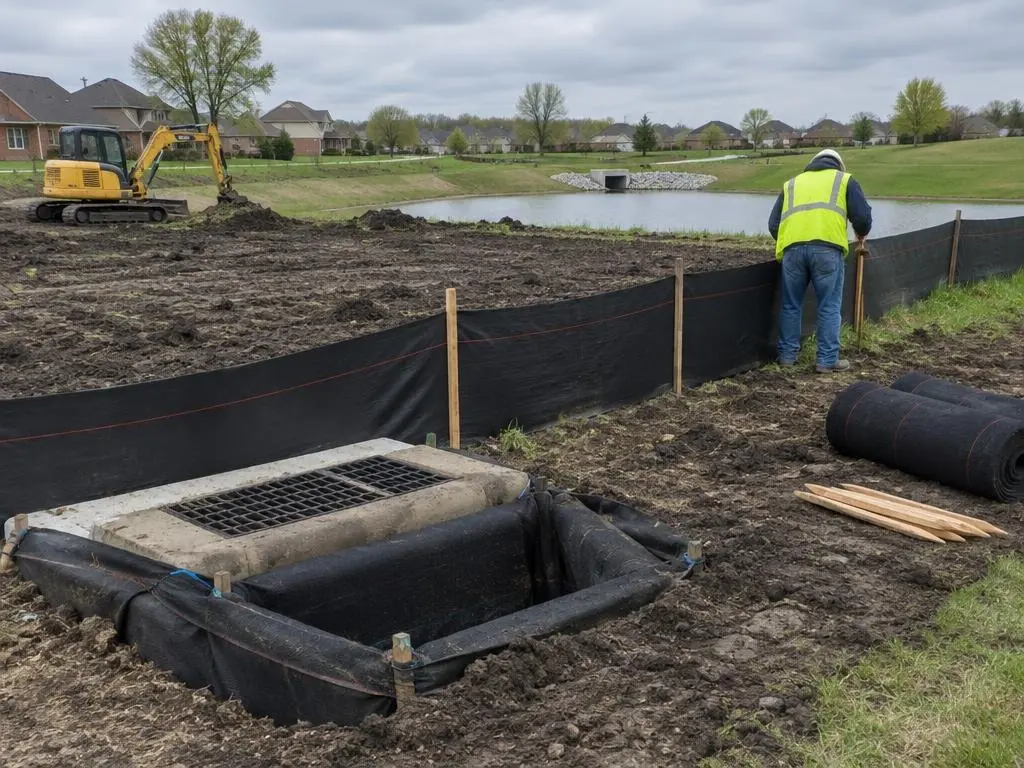
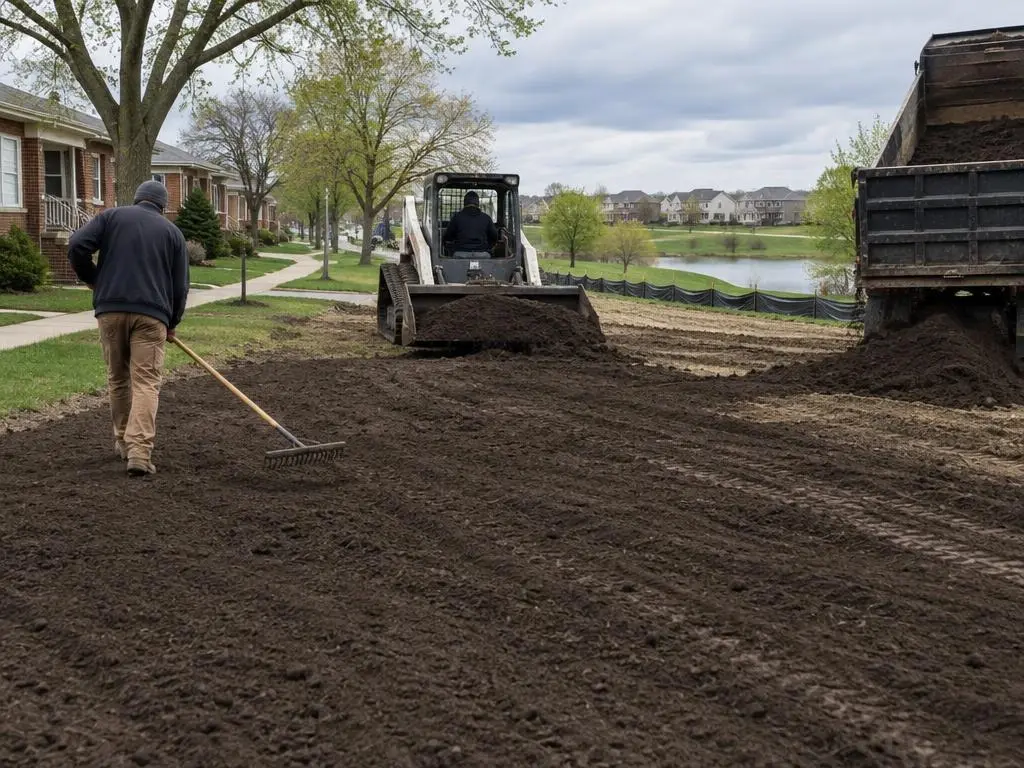
On a steep yard or berm, slope stabilization starts with the grade itself. Loose fill pushed over an edge will keep moving no matter what is on top, so we look at whether the slope needs to be cut back or compacted first. Then we roughen the surface across the slope so it holds seed and water, spray or roll the cover, and add check points in any channel that concentrates flow. On construction sites, silt fence or other sediment barriers often go at the toe of the slope as a backstop.
When to call us
Call if a swale has started cutting a channel, if a new berm or basin bank is bare, if mulch keeps washing into the street, or if a steep backyard grows weeds but never grass. Erosion control contractors are also commonly brought in when an inspector notes bare slopes on a permitted site. We can look at it, tell you what will hold, and seed it in the same visit.
Choosing seed for wet and dry spots
Swales and basin banks are wet one week and baked the next. Grass in the bottom of a swale may sit in water after a storm, while the top of the same bank dries out in a July heat wave. We use mixes that tolerate both, often with tall fescue for its deeper roots, and keep fine-bladed lawn grasses for areas that will be mowed like the rest of the yard. On larger properties, the edges of basins and steep back slopes can be good places for native grasses and wildflowers that need less mowing once they establish, and we can talk that through on the site visit if it suits the property.
After installation
Check covered areas after the first few heavy rains. Look for places where water ran under a blanket, staples pulled out, or mulch slid. Small problems are easy to fix early and hard to fix after a gully forms. We come back to look at slope and swale work after the first big storms and make repairs as needed.
Cost
Blankets are priced by area installed and hydromulch by area and rate. Table figures are 2025 transportation-department unit prices from a January 2025 erosion-control schedule, plus a residential slope surcharge from HomeGuide. We found no current published figure for BFM, so bonded fiber matrix is quoted on site once we see the slope. Our written number, set after that visit, is the one on your invoice.
Tools We Use
Matched to the slope, the flow and the timing.
Straw erosion control blankets
Rolled and stapled over seed in swales and on moderate slopes.
Straw/coir and coir blankets
Longer-lasting blankets for channels, ditches and steeper banks.
Heavy hydromulch
Extra wood or paper fiber sprayed with the seed on slopes and berms.
Bonded fiber matrix
Spray-on mulch that dries into a continuous mat for steep, hard-to-reach ground.
Swale and ditch seeding
Seed mixes that handle periodic flow and wet soil.
Slope prep
Cutting back or compacting loose fill and roughening the surface across the slope.
Typical Erosion Control Costs
| Item | Published unit price |
|---|---|
| 2025 transportation-department unit prices: 70/30 straw-coconut blanket, per 1,000 square feet | $468 |
| Same list: coir-only blanket, per 1,000 square feet | $532 |
| Same list: wood-fiber mulch, sprayed on, per 1,000 square feet | $98 |
| Same list: hand-spread straw mulch, per 1,000 square feet | $170 |
| Extra for hydroseeding steep ground, per sq ft (HomeGuide) | $0.05 to $0.10 |
| Bonded fiber matrix | Quoted on site after we see the slope |
Rate-schedule figures are agency unit prices used for reference, not Chicago quotes. Slope, access and blanket type shift the total. Guide ranges, not a bid. The bid we hand you after the visit is binding.
How We Stabilize a Slope or Swale
1. Look at the flow
We trace where water enters and leaves and how steep and long the area is.
2. Fix the grade
Loose fill compacted or cut back; swale bottoms shaped to carry water evenly.
3. Seed
A mix chosen for the moisture and sun on that slope or channel.
4. Cover
Blanket, heavy hydromulch or BFM installed over the seed.
5. Check after storms
We look at the area after the first heavy rains and repair any weak spots.
Why Choose Us for Slope & Swale Erosion Control
Right cover for the slope
Blanket, hydromulch or BFM chosen by flow and steepness, not by habit.
Grade fixed first
We do not cover loose fill and hope.
Seeding included
The same crew seeds and covers, so nothing waits between steps.
Slope & Swale Erosion Control Questions
Do I need an erosion control blanket or is hydromulch enough?
For gentle slopes and low flow, heavy hydromulch is often enough. In swales that carry real water, on steeper banks or where a storm is likely before germination, a blanket holds better. We decide on site.
Will someone need to pull the blankets off my slope later?
No. Straw and coir break down by themselves while the new turf roots through them. Some blankets use plastic netting that lingers longer; where wildlife or mowing is a concern, we can use blankets with natural-fiber netting.
What is bonded fiber matrix?
It is sprayed mulch mixed with a binder that sets up as one porous, unbroken layer. It holds seed and soil on steep ground where rolling and stapling blankets is difficult.
Why does my backyard swale keep washing out?
Usually because the swale has bare soil, is too steep along its length, or collects more water than it was shaped for. Reshaping, reseeding and a blanket usually fix it.
Slope & Swale Erosion Control Service Areas
- Hydroseeding in Chicago, IL
- Hydroseeding in Naperville, IL
- Hydroseeding in Aurora, IL
- Hydroseeding in Joliet, IL
- Hydroseeding in Plainfield, IL
- Hydroseeding in Oswego, IL
- Hydroseeding in Yorkville, IL
- Hydroseeding in Elgin, IL
- Hydroseeding in Huntley, IL
- Hydroseeding in Lockport, IL
- Hydroseeding in Lemont, IL
- Hydroseeding in Crystal Lake, IL
- Hydroseeding in Highland Park, IL
- Hydroseeding in Lake Forest, IL
- Hydroseeding in Bolingbrook, IL
- Hydroseeding in New Lenox, IL
- Hydroseeding in Algonquin, IL
- Hydroseeding in St. Charles, IL
- Hydroseeding in Romeoville, IL
- Hydroseeding in Lake in the Hills, IL
- Hydroseeding in Wheaton, IL
- Hydroseeding in Minooka, IL
- Hydroseeding in Lisle, IL
- Hydroseeding in Gurnee, IL
Get a Slope & Swale Erosion Control Estimate
Free slope and swale assessments around Chicago.